Call Us On: 0800 699 0501
Call Us On: 0800 699 0501

Direct Mail is Data Rich. But Are We Becoming Knowledge Poor?
Direct Mail has a problem, and we think we need to start talking about it.
If we do not address it, or at least acknowledge it over the next couple of years, we think the industry could face some exceedingly difficult choices.
The strange thing is, the problem is not a lack of data.
Quite the opposite.
Direct Mail has become incredibly data rich, but we are increasingly concerned we’re becoming knowledge poor.
For years and years, we’ve wanted a better understanding of the true power of the product.
Read the headlines from across the industry today and there’s a compelling case for Direct Mail in an AI-heavy world: physicality, attention, trust, its complementary relationship with digital and ever-increasing sophistication in personalisation.
Technology can help us identify precise customer groups and segments, predict behaviours and understand not just who we should communicate with, but potentially what they want and when they might want it.
Then look at what the industry now has available to it.
JICMAIL gives us behavioural data about what happens to mail in the home.
We have increasingly sophisticated response tracking.
Clients have CRM data, transactional data, digital behaviour, attribution and modelling and now increasingly powerful AI capable of interrogating all of it. That’s an astonishingly rich harvest.
Marketreach’s recent article on driving effectiveness with mail in an AI world demonstrates just how far we’ve come. It talks about attention, engagement, memorability, ROI and personalisation, with real commercial examples including Trinny London’s first UK mailing reportedly delivering sales 50% above target and a 26% uplift in average order value.
Honestly, the industry has been waiting and waiting for this stuff for years. We finally have it.
So what’s the problem?
Well, indulge us for a moment.
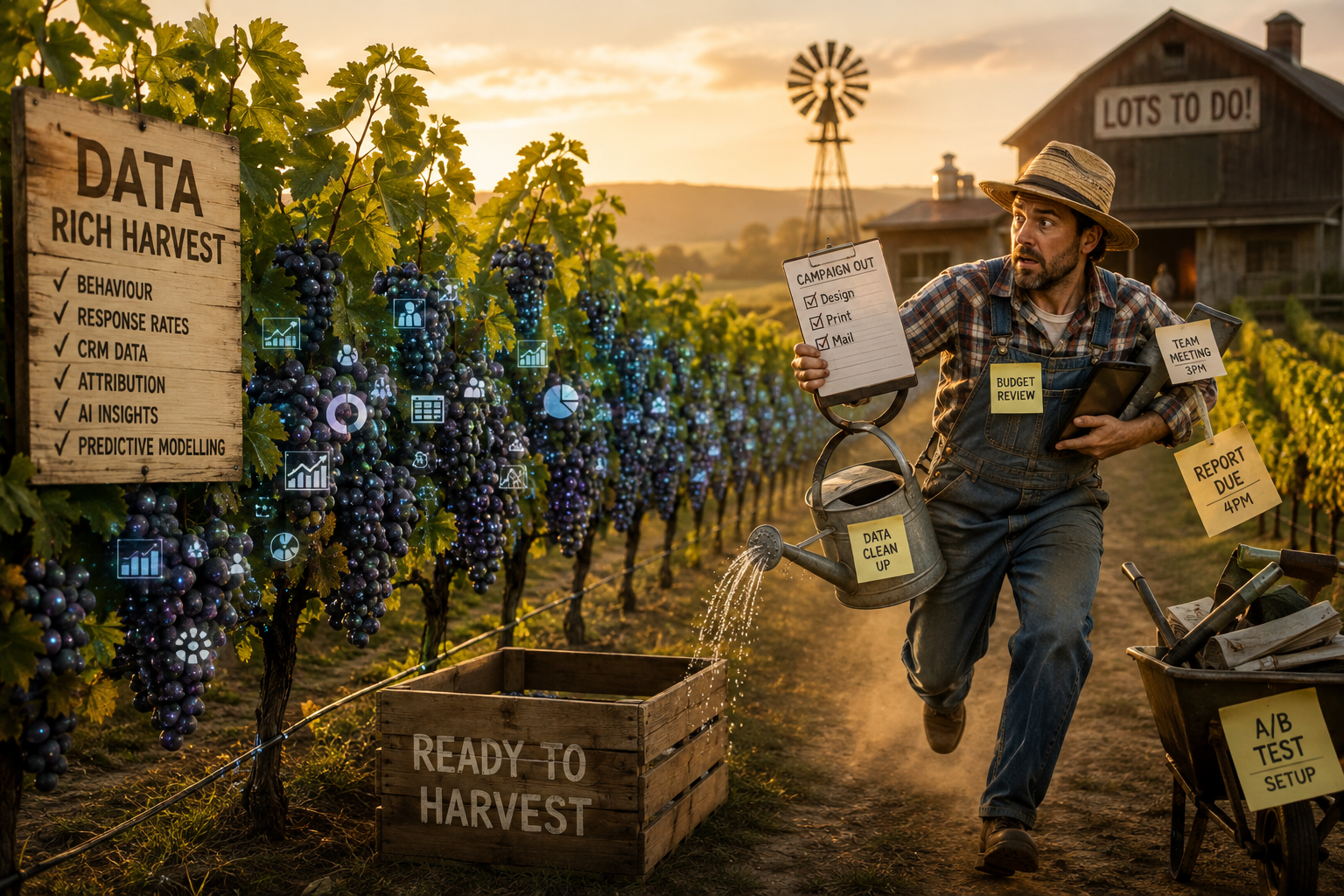
Imagine Direct Mail as an old vineyard.
It’s been around a long time. It is a little set in its ways. It has a certain charm and feel about it and produces a pretty decent bottle of wine.
But gradually, it is being pushed aside by newer, more modern vineyards.
Then a new owner arrives.
Technology is introduced. Automation. Sensors. Data. Analysis.
Suddenly we understand the soil in extraordinary detail. We know the climate, the rainfall and exactly what is happening to every vine. We can measure the grapes, predict the yield, analyse the sugar levels and calculate exactly when everything should happen.
Never have we had so much information available to help us produce exceptional wine.
There’s just one problem.
Somewhere along the way, we got rid of the winemaker.
We decided the technology knew enough.
And with them went years of experience, the feel for the product, the understanding of what worked, what didn’t, when the numbers mattered and when perhaps they didn’t.
The ability to look at all that information and ask the most important question of all: What do we actually do with it?
So the vineyard stands there, surrounded by perhaps the finest tools and richest information it has ever possessed.
Lost in a vat of data.
Time and time again, we talk to clients who want to do so much more with their mailing. They know they should. There is almost a guilt and embarrassment that they are not using all the tools they now have available to them.
Instead, there is the frustration of time and resource. They simply do not have the opportunity to step back and review.
The treadmill of campaigns is relentless, and they cannot get the break they need to stop, take a breath and really look at what they are doing.
We have taken on AI and tech-driven tools, not always to enhance marketing teams, but in some cases to replace parts of them. And that just has not worked.
Marketing teams and decision makers must be given the chance to use the tools the industry now provides, not have the tools use them.
Web Design and SEO By Eighty Eight Digital
© 2026 Central Mailing Services